Saturday, May 11, 2013

"Sunset Boulevard"

     Sunset Boulevard takes place in Hollywood in the 1950's and tells a sad story about a lonely woman living in a delusion of her past.  Norma Desmond, played by Gloria Swanson,   
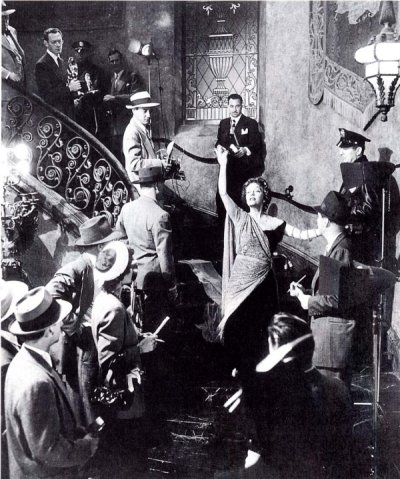
was once a famous silent film actress.  She now resides alone, except for her butler Max, in her large house decorated with pictures of her former self.  Time is passing and poor Norma patiently awaits her comeback as a movie star.  Joe Gillis, played by William Holden, is a screenplay writer looking to sell his work, but no studio is willing to buy it.  While driving along Sunset Boulevard, he winds up with a flat tire and pulls into the driveway of what appears to be an old empty mansion.  There he meets Norma and Max.  Norma manipulates Joe into staying with her after offering to assist him financially and showering him with gifts.  In return, she asks for his help on a screenplay she has been writing for herself in an attempt to return to cinema.  In an attempt to escape from Norma, Joe goes out to a friends house and runs into Betty Schaefer, a script reader.  The two had met previously, but under different circumstances, and this time they have an instant connection.  Betty has a script that she wants Joe to help her work on, and they arrange nightly meetings to work together on it.  The inevitable happens and they fall in love.  Norma eventually finds out about this and tries to sabotage them.  Provoked by anger and rage Joe reveals the truth to Norma telling her about her delusions and that she will never have the comeback she longs for.  In a fit of madness and self pity Norma pulls a gun out threatening to take her own life.  She selfishly ends up turning the gun onto Joe and pulls the trigger, killing him.  In the closing scene, as the news cameras and police arrive, Norma has become so detached from reality, she believes she is on the set of a movie.  Max plays along with her fantasy and yells "Action."  As Norma begins her dramatic walk down her grand staircase she delivers her legendary line, "All right, Mr. DeMille, I'm ready for my close-up."
     The main themes expressed throughout this film are selfishness and greed.  Norma's longing to become famous once again ultimately destroys her.  Joe selfishly used Norma for her money, which resulted in his demise. 
      I enjoyed this film very much.  Although twisted, the story was interesting and kept me on edge of my seat waiting to see what would happen next.  This film noir reminded me of the "Twilight Zone" series because of it's spooky and disturbing nature.  Also, black and white films are just able to create a sense of eeriness that color films cannot.        


"The Silence Of The Lambs"

 
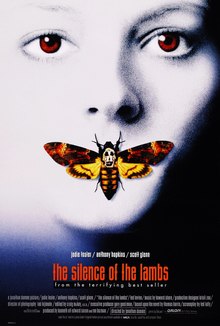
     The Silence of the Lambs is a horror film that introduces one of the most complex and interesting characters ever created, Dr. Hannibal Lecter.  He's a "monster" of a human being with a dark soul, yet you find yourself admiring his intellect.  Anthony Hopkins does an exceptional job of bringing this character to life.
     Once a respected psychiatrist, Hannibal Lecter is in prison for murdering and eating his victims.  The FBI wants his assistance in developing a psychiatric profile for another serial killer they are trying to catch, nicknamed Buffalo Bill.  A trainee named Clarice Starling, played by Jodie Foster, is chosen to try and speak with him.  The reason Clarice is selected is because she's a female.  Once he meets her, Hannibal is immediately interested in Clarice.  The two develop a "quid pro quo" relationship where if Clarice shares personal information from her past, Lecter will give her clues on how to find Buffalo Bill.  Catherine Martin, the U.S. Senator's daughter goes missing and there's reason to believe it's Buffalo Bill who has kidnapped her.  Without wasting any time because they know they have to move fast, the FBI has Clarice offer a fake deal to Lecter promising to transfer him to a different prison, if he will give her more information on Buffalo Bill.  Frederick Chilton, the head of the prison where Lecter is held has been secretly recording Clarice and Lecter's conversations and reveals to Lecter that the deal is a scam.  He then offers him a deal of his own, to which Lecter accepts and he is transferred to Tennessee, where he meets the Senator herself and gives her false information about Buffalo Bill.  However, after she comes to visit him at her own will, Lecter gives Clarice some real information that she uses to track down the real Buffalo Bill.  Meanwhile, Lecter  escapes from his cell in prison, using a pen he stole from Chilton, kills the guards and disappears.  The last scene in the film is of Clarice getting an award for catching Buffalo Bill, but she's interrupted by a phone call from Lecter.  He tells her, "I've no plans to call on you, Clarice. The world is more interesting with you in it."     
     The main theme in this film is change.  Buffalo Bill murdered young women because he wasn't comfortable in his own skin and wanted to transform himself into something different.  Just like the moth that transforms from a caterpillar, into something much more beautiful after leaving it's cocoon. 
The Silence of the Lambs is and will always be one of my all time favorite films.  It's absolutely horrifying yet keeps you on the edge of your seat, as well as has you wanting more.  Also, every single actor in this film plays their character exceptionally well.  These are all qualities that I look for in a film, and because this film meets every one of them it will for sure go down in history.              


"Notes On A Scandal"


     Notes on a Scandal is a drama which tells a story filled with deceit, infatuation, jealousy, and lies.  This film took me a little by surprise, mostly because I knew nothing about it and the twisted story I was about to see unfold.
     Judi Dench plays Barbara Covett, a lonely history teacher who lives with her cat and initially seems to long only a little companionship.  Sheba Hart, played by Cate Blanchett, is a new art teacher at the school.  Once introduced, Barbara seems to innocently admire Sheba and the two even develop a friendly relationship.  As the story continues we learn that Barbara has been keeping a diary of all of her estranged thoughts and feelings about Sheba.  After we see Barbara save a strand of Sheba's hair to put in her diary, it then becomes apparent that Barbara is developing an obsession with Sheba.  The story then takes a sharp turn when Barbara accidentally discovers a dark secret of Sheba's.  She finds out that she has been having an affair with one of her fifteen year old students.  The knowledge of this secret gives Barbara complete control over Sheba.  As she says, "now more than ever we are bound by the secrets we share".  She abuses this power she has over Sheba to continue to have a tight grasp on her friendship.  The story begins to climax after Barbara purposely lets Sheba's secret slip to another staff member at the school.  Sheba's downward spiral then begins from her shame and embarrassment.  In the midst of turning to Barbara as a friend for comfort Sheba discovers the diary.  In it she finds all of Barbara's psychotic feelings and appalling thoughts towards Sheba and her family.  The movie ends with Barbara meeting another woman in the park whom we can assume is going to be her next victim.
     One theme I would say, that pertains mostly to Barbara's character is, "misery loves company." Barbara was an overly jealous, sad, lonely woman whose intentions were to sabotage a woman who she viewed as being perfect and happy.  Although Sheba was not so innocent herself, due to her infidelity, it was still unfortunate for her that she found herself tangled in the web that Barbara Covett wove.
     I believe that one of the contributing factors to the enjoyment of a film involves a convincing performance from the actors.  The acting in this movie was superb, which made it very easy to feel truly involved in the story.  It was precisely because of the quality of the acting and the power of the story itself that made this film worth watching.  I genuinely appreciated this film, however, it's negative themes and depressing nature was the only reason I did not enjoy it.

"My Neighbor Totoro"

     "My Neighbor Totoro" is a wonderful animated film that tells an enchanting story about two sisters named Satsuki and Mei.  Along with their father, Satsuki and Mei are a family missing their mother who is sick and in the hospital.  The story opens with the family beginning to explore a new house, which they moved into to be closer to the hospital where their mother is.  While laughing and smiling the girls are having a look around their new home and are already beginning to make magical discoveries.  Mei peeks into a dark room to find hundreds of little eyes, and being the innocent child that she is, Mei is curious about her new discovery.  The little dust bunnies scatter away at the sight of her but we watch in joy as she tries desperately to capture one.  We learn that these little balls of soot are only seen by the children and soon leave the house after the girls begin to have fun and laugh along with their father.  As a result of their countryside property being so large, adventure lurks around every corner of this new unexplored land.  Mei stumbles upon two rabbit-like creatures in the yard and follows them into the trees behind the house.  There she meets Totoro, and she can't believe her eyes.  Totoro is an enormous, scary-looking, yet friendly creature of the forest.  He's sleeping but Mei is unafraid and sits atop his belly.  She stares in disbelief, plays with him, and eventually falls asleep on him.  When her sister and father find her sleeping on the ground and wake her, Totoro has disappeared.  Satsuki expresses her wish to meet Totoro too, and she eventually does one night while the girls wait for their father to return from work at the bus stop.  It's raining and Satsuki looks up from her umbrella to find Totoro standing next to her.  He hands her a bundle of acorns and seeds, which Satsuki and Mei plant right away.  The children's imagination takes flight as they witness an entire forest begin to grow from the seeds, which brings them joy.  Later, Satsuki gets a phone call of bad news from the hospital where her mother is and Satsuki, out of anger and frustration, yells at her little sister.  Mei then runs away in an attempt to visit her mom at the hospital and winds up getting lost.  Satsuki begs Totoro to help her find Mei, and he does. The story comes to a happy ending as their mother returns home from the hospital and Totoro and his friends watch over the family, unseen.
     Aside from the ongoing theme of sisterly and family love, the most powerful theme in this film is the magical imagination of Mei and Satsuki.  In their minds they create an incredibly colorful world of make-believe where they are taken on wild adventures.  Absolutely nothing can compare or is more endearing than what a child's imagination can dream up.
     I absolutely loved this film.  The magic and adventure brought me back to my own childhood.  Films like this, although animated and meant to be viewed by a younger audience, have the power to awaken and bring to life the child inside any adult.  Along with the smile that was on my face throughout the entire film, that's exactly what this film did for me.   


"Born Into Brothels"

 
     This powerful documentary, Born into Brothels, takes place in Calcutta, India.  The directors, Zana Briski and Ross Kauffman, wanted to take a closer look into the red light district in this poverty stricken area.  Initially, the director's intentions were to photograph the lives of the prostitutes living in the brothels.  After meeting several of the children that lived there she was inspired to shed light onto their day to day lives.  Her focus remained on the children and the harsh conditions of poverty, uncleanliness and abuse they lived in.  With the intention of involving the children in something positive, Zana began to teach the children about photography.  She gave them each a camera of their own to photograph the world through their eyes.  Immediately the children begin to show a tremendous amount of talent with their new found art.  As their photography advanced Zana organized exhibitions to showcase their work.  By the end of the film, Zana managed to arrange for most of the children to attend boarding schools.  Unfortunately, some of the children were unable to leave the brothels and some of the one's that did, returned shortly after.   A few, went on to continue their education, and even receive good grades.  This was most likely the true reward for Zana.  To see these children excel just because they were given a chance at their dreams.    
     The main theme in this film is hope.  Zana instills an enormous amount of hope in these children and works hard to inspire them.  Letting them know that with her help they can be whoever they want to be by getting an education.  She opens their eyes to the world around them at first through the lens of a camera, but then allows them to see the bigger picture, and to have dreams.  
     This film pulled at my heart strings and was truly an inspiration.  These two directors were determined to shed light on these children for the world to see the conditions they were living in and how they were being treated.  They also genuinely wanted to help them, by removing them from a toxic environment, giving them a new life, and an education.  But most importantly hope for a better tomorrow.